


Quick Answer: What Is VOX on a Walkie Talkie?
VOX, commonly used to describe voice-operated transmission, starts the radio transmitter when the microphone detects speech above a configured audio threshold. It allows a user to communicate without continuously pressing the PTT button, but it does not remove the need for correct channel programming, a suitable headset, noise calibration, and local radio compliance. For B2B fleets, VOX is most useful when both hands must remain available, while PTT is usually more predictable in noisy or radio-critical environments.
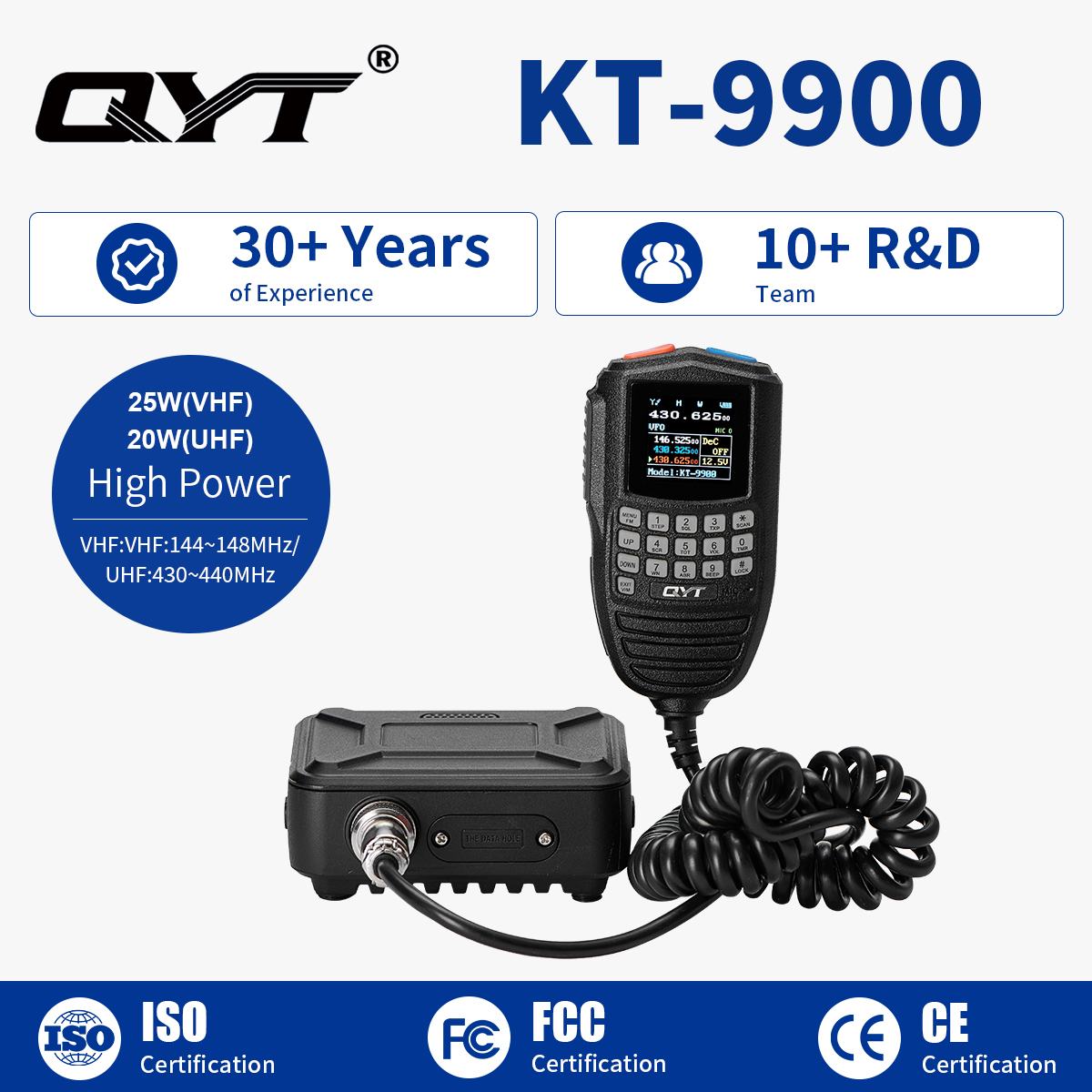
QYT product manuals identify VOX or VOX/Sensitivity functions on applicable radio models. The QYT KT-9900 manual lists a VOX menu and a VOX-T voice-control delay menu; its documented setting table describes VOX 0 as off, 1–10 as voice-control sensitivity levels, and VOX-T as a selectable delay setting up to 20. These are KT-9900 manual values, not a universal QYT-family specification. Buyers should confirm the final model, firmware, compatible earpiece, and programming method before placing a fleet order.
What Are the Main VOX Takeaways for Professional Radio Buyers?
- VOX is voice-triggered transmission: the radio switches to transmit when the microphone detects speech that crosses its activation threshold.
- VOX is not automatically better than PTT: it is an operating mode for specific tasks, not a universal replacement for manual transmission.
- Sensitivity must match the environment: a setting that works in a quiet corridor may transmit unintentionally beside machinery, traffic, alarms, or wind.
- A compatible headset is normally required: an acoustic tube earpiece, boom microphone, or approved speaker microphone can keep the microphone close to the user and reduce unwanted audio pickup.
- VOX delay matters: a short hold or delay can keep the end of a word from being cut off; the correct setting depends on the radio menu and speaking pattern.
- Model-level verification is essential: QYT CB, KT, and M series radios have different use cases and specifications. Do not assume that a VOX function, sensitivity range, headset connector, or water-resistance rating applies to every model.
- A fleet needs a standard procedure: buyers should define the channel, headset, VOX level, delay, battery plan, and fallback-to-PTT rule before deployment.
How Does VOX Work Inside a Walkie Talkie?
A VOX-enabled radio continuously monitors the microphone input while it is in receive or standby mode. When the detected audio exceeds the configured threshold, the radio opens the transmitter. When speech stops, the radio waits for the configured release or delay period and then returns to receive mode.
The operating sequence is therefore:
- The radio remains on the assigned channel.
- The microphone detects voice or other sound.
- The audio crosses the VOX activation threshold.
- The transmitter starts automatically.
- The user speaks through the headset or microphone.
- The voice signal disappears or falls below the threshold.
- The VOX-T or release delay keeps the transmitter open briefly.
- The radio returns to receive mode.
This explains why VOX can create two opposite problems. If the threshold is too low, background noise can trigger transmission. If the threshold is too high, the first syllable may be missed or the radio may stop transmitting between words. A practical fleet test should check both false activation and speech completeness.
What Does VOX Mean on a Walkie Talkie?
VOX means that the radio uses detected voice input to control transmission instead of requiring a manual PTT press for every sentence. The exact implementation differs between models. Some radios provide a simple on/off function; others provide sensitivity, delay, or multiple menu values.
For procurement documents, the term VOX walkie talkie should be defined more precisely. Ask the supplier to confirm:
- Whether VOX is available on the proposed model.
- Whether VOX works through the built-in microphone, an accessory connector, or both.
- Whether an approved earpiece or boom headset is required.
- How sensitivity is adjusted.
- Whether transmission delay is adjustable.
- Whether the radio returns to receive mode automatically after speech stops.
- Whether VOX can be disabled quickly and replaced by PTT.
- Whether the selected headset remains suitable for the intended water, dust, impact, and temperature conditions.
How Should a Buyer Set VOX Sensitivity?
The correct VOX sensitivity is the lowest setting that reliably detects the user’s normal speech without responding to ordinary background noise. There is no universal “best” level because the same radio can be used in a quiet hotel corridor, a warehouse aisle, a construction site, or a moving vehicle.
Use this controlled adjustment procedure:
- Fit the headset exactly as it will be worn during work.
- Select the approved operating channel and confirm that the radio can receive normally.
- Start with VOX disabled or at the lowest practical activation level.
- Speak using the normal work volume, not an exaggerated test voice.
- Increase sensitivity one step at a time until normal speech reliably starts transmission.
- Stop increasing the setting once speech is detected consistently.
- Test ordinary background sounds without speaking.
- Walk, turn the head, handle equipment, and perform the actual task.
- Confirm that alarms, machinery, vehicle movement, wind, and nearby conversations do not create repeated false transmissions.
- Record the final sensitivity, delay, headset model, channel, and user group in the fleet configuration sheet.
Which VOX Setting Should Be Used in a Noisy Warehouse?
A noisy warehouse should not receive a universal preset such as “level 3” or “level 5” without testing the actual radio and headset. OSHA’s current occupational-noise guidance says that exposure at or above 85 dBA as an 8-hour time-weighted average triggers a hearing-conservation program, while engineering or administrative controls are required above 90 dBA as an 8-hour average; these limits are workplace-noise references, not VOX settings. Use a higher activation threshold when machinery or vehicle noise triggers the transmitter, but verify that ordinary speech is still detected. If the radio requires the user to speak loudly, misses the first word, or transmits intermittently, the sensitivity is too high or the microphone position is unsuitable. Source: OSHA Occupational Noise Exposure, accessed 2026.
For warehouses, buyers should also consider whether PTT is safer for short, critical messages. A forklift operator, picker, or supervisor may benefit from VOX during a two-handed task, but the same team should be trained to return to PTT when background noise makes VOX unreliable.
Which VOX Setting Should Be Used on a Construction Site?
Construction sites combine engine noise, impact noise, alarms, wind, dust, and changing distances between workers. Test VOX at the exact work position, with the intended headset under the required protective equipment. A boom microphone placed close to the mouth can improve speech detection, while a remote speaker microphone may be more practical when a helmet or hearing protection changes the acoustic path.
Do not treat a recommended starting point as a certified radio parameter. The final setting must be validated by the site communication manager and recorded in the equipment issue procedure.
Which VOX Setting Should Be Used for Security Patrols?
Security patrols often move between quiet indoor areas, entrances, parking areas, and traffic zones. A single VOX setting may not work equally well across all locations. Buyers should test the radio at access gates, loading bays, elevators, stairwells, and vehicle areas, then decide whether a patrol group needs VOX, PTT, or a quick-access operating profile.
For security work, accidental open-mic transmission can block a channel and expose unnecessary background audio. A clear fallback-to-PTT rule is therefore more important than choosing the most sensitive setting.
What Is the Difference Between VOX and PTT?
PTT requires a deliberate button press. VOX uses detected speech to start transmission. Both modes use the same radio channel and share the same half-duplex limitation: when one radio is transmitting, other users on the same channel must wait to speak.
| Dimension | PTT (Push-to-Talk) | VOX (Voice-Activated) |
|---|---|---|
| Operation method | User presses and holds a button | Radio starts transmission after detecting speech |
| Best use case | Predictable, controlled communication | Tasks where both hands are occupied |
| Noise tolerance | Less affected by background sound because activation is deliberate | Requires sensitivity calibration in the actual noise environment |
| False-trigger risk | Low when the button is not pressed | Possible if machinery, wind, alarms, or nearby speech crosses the threshold |
| Speech-start control | User controls the exact start of transmission | May require microphone placement and sensitivity adjustment |
| Headset requirement | Optional, depending on the radio and task | Usually recommended or required for reliable operation |
| Channel management | Easier to control short calls manually | Requires a delay and a clear speaking procedure |
| Fallback option | Normal operating mode | Should be switchable to PTT when conditions change |
The right question is not “Is VOX better than PTT?” The right question is “Which operating mode produces the fewest missed words, accidental transmissions, and unsafe distractions in this work environment?”
What Headset Is Needed for a VOX Walkie Talkie?
A VOX headset should keep the microphone close enough to the user’s mouth to capture normal speech while reducing pickup from the surrounding environment. The exact connector, wiring, PTT arrangement, and electrical specification must match the radio model.
Common headset configurations include:
- Boom microphone headset: useful when the microphone must remain in a fixed position near the mouth.
- Acoustic tube earpiece: discreet for security, reception, and service teams, subject to model compatibility.
- Speaker microphone: useful when the user needs audio near the shoulder, but the microphone should be tested carefully in noisy areas.
- Industrial hearing-protection headset: suitable only when the radio connector, microphone wiring, PTT circuit, and environmental requirements are confirmed.
- Helmet-compatible headset: useful for construction and field work when the microphone position remains stable under protective equipment.
Avoid selecting a headset only by plug appearance. Two accessories may look similar while using different pin assignments, PTT circuits, microphone characteristics, or radio wiring. For a fleet order, request a compatibility confirmation for the radio model, accessory part, connector, microphone type, PTT behavior, and VOX operation.
Which QYT Earpiece Models Can Buyers Include in a VOX RFQ?
QYT’s supplied accessory list includes the following earpiece and headset product names. The list identifies available accessory references; it does not by itself confirm connector pinout, microphone type, PTT wiring, radio compatibility, or VOX performance. Buyers should request a model-to-accessory compatibility confirmation before placing a fleet order.
QYT’s accessory list includes P200-PM01, P115-PM13-G5, P200-PK01, MT811-PK01B, 4025-M, P07C-PK01, P109-PM01-G4, P218L-PM11, P102-PM01-G3, and P115-PH07-G3-S. For each of these references, the buyer should confirm the intended radio model, connector, microphone, and PTT compatibility before ordering.
The list also includes the MT06C-PK01 half-helmet version, P09-PK01, P09-PM01, and EG19. For these accessories, the buyer should confirm the complete accessory version and wiring before ordering. For EG19 3.5, the connector specification and intended radio model should be confirmed separately. The accessory names come from QYT’s supplied list; the list itself does not prove VOX performance or cross-model compatibility.
Which Documented QYT Parameters Should Buyers Compare Before Ordering?
| QYT model or family | Documented product evidence | VOX procurement implication |
|---|---|---|
| CB-58 | 26.965–27.405 MHz; FM/AM; 10 kHz channel separation; 4 W rated output in the tested configuration | Confirm whether the requested CB configuration and accessory set support the intended hands-free workflow |
| KT-9900 | Manual lists VOX and VOX-T menus; the setting table describes VOX off/levels and a selectable delay setting | Confirm final firmware, sensitivity range, delay behavior, connector, and headset wiring |
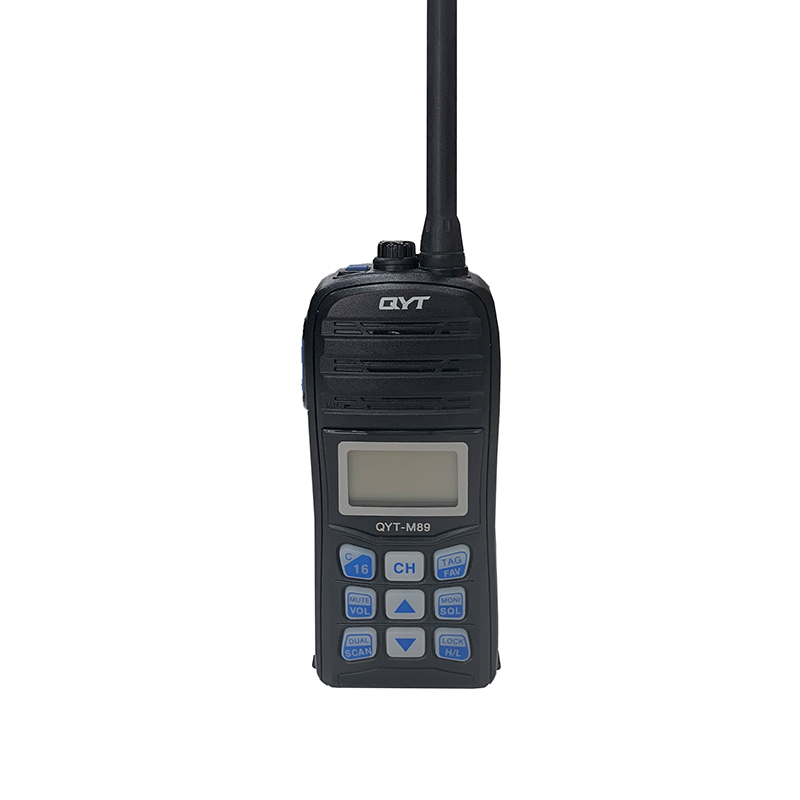
| M89 | IP67 under a 1 m/30 min condition; float function; 70 programmable channels | Do not infer VOX or headset water protection from the marine enclosure rating |
| M898 | IP67 under a 1 m/30 min condition; float function | Confirm VOX availability and external-accessory environmental rating separately |
The table separates documented facts from purchasing questions. It is not a substitute for the final model datasheet, user manual, regulatory review, or accessory compatibility confirmation.
Which Industries Benefit Most from VOX Walkie Talkies?
How Can Construction Teams Use VOX Safely?
Construction teams can use VOX when a worker is handling tools, guiding a lift, moving materials, or working in a position where pressing PTT is inconvenient. The operating procedure should specify the headset, microphone position, activation test, maximum message length, and PTT fallback.
A crane operator or signal person should not rely on VOX if engine noise repeatedly opens the transmitter or if the team cannot verify that the first word is captured. For safety-critical instructions, the project communication plan should define confirmation words and a backup method.
How Can Warehouse Teams Use VOX During Picking and Loading?
Warehouse pickers and loading teams may use VOX when both hands are occupied. The deployment should be tested around forklifts, conveyors, reversing alarms, scanners, loading doors, and battery charging areas. Supervisors should monitor open-mic events during the first shift and adjust sensitivity or move the group back to PTT when the channel becomes congested.
How Can Security Teams Use VOX Without Blocking the Channel?
Security teams can use VOX with a close-fitting earpiece and a defined short-message procedure. The user should pause briefly before speaking, identify the intended colleague or location, deliver the instruction, and avoid side conversations near the microphone. If false activation occurs at gates or in traffic areas, the patrol procedure should require PTT.
How Can Medical or Care Teams Evaluate Hands-Free Radio Communication?
Medical and care teams should evaluate VOX with privacy, hygiene, alarm noise, protective equipment, and infection-control procedures in mind. A headset must be approved for the work environment, cleaned or replaced according to the organization’s procedure, and tested for reliable speech detection. VOX should not be described as a substitute for a validated clinical communication system unless the organization has completed its own risk assessment.
What Should a B2B Buyer Include in a VOX Radio RFQ?
A useful RFQ should describe the work environment rather than simply ask for “a VOX walkie talkie.” Include the following information:
- Industry and operating scenario.
- Number of radios, spare units, batteries, chargers, and headsets.
- Indoor, outdoor, vehicle, marine, or mixed deployment.
- Main noise sources and expected speech distance.
- Required frequency band and destination-market rules.
- Channel count, channel labels, CTCSS/DCS or other signaling requirements.
- VOX on/off requirement and desired sensitivity adjustment method.
- VOX delay or release behavior required by the work procedure.
- Headset type, connector, PTT arrangement, and replacement plan.
- Water, dust, impact, salt-mist, float, or temperature requirements.
- Factory pre-programming and channel-label requirements.
- Logo, housing, packaging, manual, or other OEM/ODM requirements.
- Required test reports, declarations, manuals, packing list, commercial invoice, and other export documents.
- Warranty scope, spare parts, and technical-support process.
QYT provides contact access through its official website for buyers who need model matching, accessory confirmation, factory programming, or an OEM/ODM discussion. The final quotation and product configuration should be based on the confirmed model, destination market, quantity, and accessory list.
What Is a Practical VOX Training Procedure for a New Fleet?
Use this five-step onboarding procedure:
- Explain the limitation: VOX does not make the channel full-duplex; only one user can transmit at a time on the same channel.
- Fit the equipment: install the approved headset and place the microphone consistently.
- Test the setting: speak normally, test background noise, and confirm that the first and last words are complete.
- Practice the fallback: every user should know how to disable VOX or press PTT when the environment changes.
- Record the configuration: document model, firmware, channel, VOX setting, delay, headset, battery, and supervisor approval.
A short written procedure is more valuable than a generic instruction to “speak louder.” It creates a repeatable operating standard for onboarding, shift changes, replacement headsets, and future fleet expansion.
What Commercial Deployment Scenarios Should Buyers Plan For?
What Should a Construction Crane Operator VOX Package Include?
An illustrative construction procurement plan may specify a 50-unit VOX headset package for crane operators, signal persons, supervisors, and spares. This is a planning scenario, not a completed QYT order or a universal QYT product claim. The RFQ should define the radio model, frequency plan, headset type, helmet compatibility, sensitivity test, delay test, PTT fallback, spare ratio, and site acceptance procedure.
What Should a Hospital Hands-Free Communication Evaluation Include?
A hospital team evaluating hands-free communication should first define the rooms, alarm conditions, cleaning process, user roles, privacy requirements, and acceptable failure mode. The organization should test whether VOX reacts to alarms or nearby speech, whether the headset can be maintained hygienically, and whether PTT remains available for controlled messages. A supplier should receive the approved specification before recommending the final radio and accessory combination. For ships and maritime fleets, IMO states that the GMDSS has been fully implemented since 1 February 1999 and that passenger ships and cargo ships over 300 gross tonnage on international voyages must carry specified distress and safety communication equipment under SOLAS; a portable VOX radio must not be presented as a replacement for required GMDSS equipment. Source: IMO Radiocommunications.
What QYT Commercial Reference Can Buyers Review?
QYT internal sales material records a 500-piece CB-58 OEM order case involving customization and export-order coordination. That documented case demonstrates the type of information a B2B buyer should prepare for a fleet project: quantity, branding requirements, packaging, configuration, commercial terms, and delivery coordination. It does not prove that every CB-58 order includes VOX or that the case used a VOX headset package; those details must be confirmed separately for the requested model. QYT’s FAQ materials also state that the factory supports logo customization, video factory audits by prior arrangement, technical support for a buyer’s sales team, and shipment documents including commercial invoice, packing list, and logistics proof. These are service statements from the referenced FAQ, not a promise that every order has identical terms.
What Should a Buyer Check Before Approving a VOX Fleet?
- Has the selected model been confirmed to support VOX?
- Has the exact VOX menu, sensitivity range, and delay behavior been documented?
- Has the compatible headset or speaker microphone been confirmed in writing?
- Has the radio connector and PTT wiring been checked?
- Has the final setting been tested in the real noise environment?
- Can users switch back to PTT quickly?
- Are channels, signaling codes, labels, and frequency permissions correct?
- Are battery, charger, spare, and cleaning requirements included?
- Are water, dust, impact, marine, float, and temperature requirements matched to the model?
- Are factory pre-programming, logo, packaging, and manual requirements clear?
- Are applicable test reports, declarations, and export documents identified?
- Is there a training sheet for new employees and temporary workers?
What Are the Most Common VOX Walkie Talkie Mistakes?
- Choosing sensitivity by number alone: a higher number is not automatically better.
- Using the built-in microphone in a loud area: background noise may trigger the transmitter.
- Buying an unverified headset: connector appearance does not prove electrical compatibility.
- Ignoring the delay setting: short delays may clip the end of words; long delays can keep the channel occupied.
- Treating VOX as private communication: VOX does not automatically provide privacy or encryption.
- Skipping PTT training: users need a manual fallback when noise or equipment changes.
- Assuming one model’s feature applies to a family: VOX, IP rating, float function, frequency, power, and accessory support must be checked by model.
- Deploying without a channel procedure: open-mic events can block other users and reduce operational clarity.
What Do Buyers Frequently Ask About VOX Walkie Talkies?
What Does VOX Mean on a Walkie Talkie?
VOX means voice-operated transmission. The radio automatically starts transmitting when the microphone detects speech above a configured threshold, so the user does not need to press PTT for every message.
How Do I Turn On VOX Mode on My Walkie Talkie?
Open the radio’s function or menu settings, locate VOX, select the required sensitivity, and confirm the setting. The exact menu path differs by model; follow the model manual and test with the approved headset before deployment.
What Is the Best VOX Sensitivity Setting for a Noisy Warehouse?
There is no universal best setting. Start at a low practical activation level, increase it until normal speech is detected, then test forklifts, alarms, conveyors, and nearby conversations to remove false triggers.
Do I Need a Special Headset for a VOX Walkie Talkie?
Usually, yes. A compatible boom headset, acoustic tube earpiece, or speaker microphone helps place the microphone correctly and reduce unwanted audio. Connector, wiring, microphone type, and PTT compatibility must be confirmed by model.
What Is the Difference Between VOX and PTT?
PTT starts transmission when the user deliberately presses a button. VOX starts transmission when the microphone detects speech. PTT is generally easier to control in noise, while VOX is useful when both hands are occupied.
Does VOX Work in All QYT CB, KT, and M Series Radios?
No universal assumption should be made. QYT manuals identify VOX or VOX/Sensitivity on applicable models, but buyers must verify the selected model, firmware, accessory connector, headset, and intended environment before ordering.
Does a Marine Radio’s IP Rating Prove That Its VOX Headset Is Waterproof?
No. A radio’s IP rating describes the tested protection of the radio under specified conditions. It does not automatically certify every external headset, cable, connector, or VOX accessory for the same environment.
Which Sources Support the Technical and Procurement Claims in This Guide?
- QYT KT-9900 manual: VOX and VOX-T menu definitions, including the documented sensitivity and delay settings.
- QYT CB-58 test documentation: tested frequency range, modulation, channel separation, rated output, and external-antenna information.
- QYT M89 and M898 manuals: model-specific IP67, float, and programmable-channel statements.
- QYT accessory list: supplied earpiece and headset references listed in the procurement table.
- FCC DA 07-881: United States CB channel range and equipment-authorization context.
- OSHA Occupational Noise Exposure: 85 dBA 8-hour TWA hearing-conservation threshold and 90 dBA control reference.
- IEC IP ratings: interpretation of the two-number ingress-protection code.
- IMO Radiocommunications: GMDSS and SOLAS communication-equipment context for maritime procurement.
- QYT FAQ and OEM case materials: logo customization, factory-audit arrangement, technical support, shipment-document references, and the recorded 500-piece CB-58 OEM case.
